
Considered by historians to have been one of the greatest commanders of all time, Alexander the Great‘s tactics influenced military strategists for centuries. Skillful, daring, and ambitious, by the age of 32, he had established an empire that stretched from Greece and Egypt to the Indian subcontinent.
Born in Pella, in the ancient Greek kingdom of Macedonia, Alexander was the son of Philip II
and his fourth wife, Olympias. In Alexander’s early education, he strongly identified with Achilles and Odysseus, the heroes of Homer’s epics, The Iliad and The Odyssey, and from an early age, he sought to emulate their achievements. When Alexander was just 16 years old, he ruled Macedonia as regent in his father’s absence, crushing an uprising in Thrace. Two years later, Alexander led the cavalry charge at the Battle of Chaeronea in 338 bce, and, according to the GreekRoman biographer Plutarch, he was the first to force a breach in the enemy line, winning a key victory for his father.
MILESTONES
INSPIRED BY HOMER Tutored by Aristotle in 343 bce, and reads Homer’s works, The Iliad and The Odyssey.
BECOMES KING Succeeds his father and becomes King of Macedonia, 336 bce. Crushes early dissent.
BUILDS ALEXANDRIA Founds a new Greek city, Alexandria, 331 bce, as a Hellenistic center in Egypt.
DEFEATS PERSIA Takes control of Persian Empire after decisive Battle of Gaugamela, 331 bce.
The new king
After Philip II’s assassination in 336 bce, Alexander, aged 19, became king of Macedonia. Immediately, he began quelling rebellions sparked by the death of his father. After killing his main rival, Attalus, Alexander crushed an uprising in the Greek city of Thebes—the first example of his use of ruthless terror to suppress rebellion. Alexander’s first military expedition saw him
defeat an uprising by local chiefs in the Danube Valley, north of Macedonia, in 335 bce. In order to safely cross the river and gain the upper hand, he moved his entire army, with horses and equipment, across the river overnight on rafts made of animal skins stuffed with straw. Alexander’s ability to improvise solutions under pressure, based on an astute reading of the landscape and situation, would be demonstrated throughout his career.
Building an empire
With his European lands secure, the 22year-old Alexander turned his attention east toward Persia, intent on further conquests. Leading a carefully prepared expedition, he crossed the Hellespont, the body of water separating Europe from Asia Minor, into Anatolia. Alexander’s powerful army consisted of 5,000 Macedonian and Thessalonian cavalry and 40,000 Macedonian and Greek infantry, including Thracian javelin throwers and Cretan archers. His army’s first victory against the Persians came at Granicus (Turkey) in 334 bce. There, he used tactics gleaned from his father;Philip II had long utilized a phalanx formation—a huge rectangular mass of soldiers armed with shields and pikes. Unlike previous uses of this formation, Alexander’s version of the phalanx included skirmishers and cavalry, which reinforced their attack. The next year, Alexander confronted
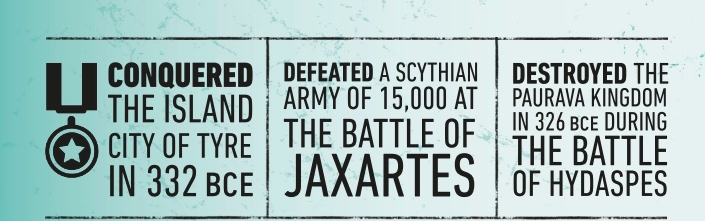
the Persian King Darius III and his army on the plains of Issus (Turkey). In one of the decisive battles of the ancient world, Alexander defeated the much larger Persian army, but Darius escaped. Alexander then moved on to Egypt, part of the Persian Empire, taking Tyre (Lebanon) and Gaza (Palestine) en route.
“Approach me, therefore, as the lord of all Asia.”
Alexander the Great, 332 bce
While in Egypt, Alexander used a passage from The Odyssey to identify a nearby fishing village as the site on which to build a city. He named it Alexandria, and it went on to become a center for trade between Europe and the East and the largest city in the ancient world. In 331 bce, Alexander defeated Darius III at Gaugamela (Iraq), although he was once again outnumbered. Shortly after, he captured the administrative capital of Persia: Babylon (Iraq). Darius fled once more, but was later murdered by a small group of conspirators led by his cousin Satrap Bessus. In 330 bce, Alexander proclaimed himself successor to the Persian throne. The Macedonians believed this would bring an end to his campaigns, but he pressed on, enforcing his
claim on all Persian domains and extending his empire into India.
The turning point
After invading the Punjab, in
Northern India, in 326 bce, Alexander
defeated King Porus of the Pauravas at the Battle of the Hydaspes. His army then faced another battle at the River Hyphasis (Beas) in the Himalayas, but his men were outnumbered and suffered huge losses. Demoralized and exhausted at the prospect of further military campaigns, Alexander’s armies began to mutiny. Heeding his people’s needs, Alexander agreed to return home. Part of Alexander’s success in building his empire came from him embracing the customs of the civilizations that he conquered. However, these were not met with such enthusiasm by his Macedonian followers and veterans. Many became jealous as increasing numbers of new Persian followers found favor with Alexander. Discontent was expressed in a series of mutinies that Alexander violently suppressed.
His legacy
When he died of a fever in Babylon on June 11 323 bce, he left no heir (his son by his wife Roxana, a Sogdian princess, was born after his death). However, he left a strong legacy as the passage of his army led to unprecedented cultural and religious exchanges between East and West, as well as the expansion of trade routes and the founding of many cities. In antiquity, his fame was unequalled, and he was so revered by his followers that his embalmed body was taken to Egypt where it was displayed for more than 500 years.
PHILIP II OF MACEDON
Philip II (382–336 bce) was king of Macedon and Alexander’s father.
When Philip ascended the throne in 359 bce, he embarked on a long campaign to reform and strengthen the Macedonian army. He brought peace to his country and, following the Battle of Chaeronea in 338 bce, established dominance over the Greek city-states, thereby paving the way for his son’s far-reaching conquests. In 336 bce, Philip was assassinated by his bodyguard while planning an invasion of the Persian Empire.

Addressing troops before the Battle of Issus as quoted in Anabasis Alexandri by Arrian of Nicomedia, Book II, 200 ce
 Vnoteshistory
Leave a comment