
Better known as the Buddha, Śiddhartha Gautama is revered as the founder of one of the oldest and most widespread of world faiths—Buddhism. An Eastern philosophy and religion, it teaches that life is a process of working toward freedom from suffering.
Śiddhartha (meaning “he who achieves his aim”) Gautama was born into the Shakya tribe in Lumbini (modern-day Nepal), in the 6th century bce. The tribe was poor and isolated, but Śiddhartha’s father, Śuddhodana, was the leader, and built a palace where his son, the prince, could live in luxury.
Path to enlightenment
According to Buddhist tradition, Śiddhartha’s father ordered the people to hide all signs of human suffering from his son. When Śiddhartha finally ventured out of the palace without his father’s knowledge, he was deeply shocked to learn of illness, old age, and death. In response, he left his home, his wife, and his newborn son Rāhula, to seek the truth of human existence. For a few years, Śiddhartha tried to emulate holy men (such as the hermit saint
Alara Kalama), and follow a life of study, prayer, and meditation, but their guidance failed to help him achieve spiritual release. Then, meditating alone under a pipal tree (Ficus religiosa), he came to see things as they truly were. When he realized that the causes of suffering are greed, selfishness, and stupidity, and that eliminating these traits would free people from suffering, he reached Nirvana, a state of pure enlightenment, and became the Buddha (“he who is awake”).
“All conditioned things are impermanent—when one sees this with wisdom, one turns away from suffering.”
The Buddha
MILESTONES
KEPT FROM REALITY Spends his life until early adulthood in his father’s palace shielded from human suffering.
SHOCKED BY TRUTH Upon leaving the palace, discovers reality of life. He leaves his family to become a holy man.
SOURCE OF SUFFERING After meditating, learns that greed, stupidity, and selfishness are causes of human misery.
PATH TO NIRVANA Develops philosophy of Four Noble Truths and Eightfold Path as a means to reach Nirvana.
SPREADS HIS IDEAS Aged 35, attracts his first disciples. Founds Sangha (monastic order) and sets out dharma (teachings).
During the Buddha’s first sermon, he “set in motion the wheel” of his
DALAI LAMA
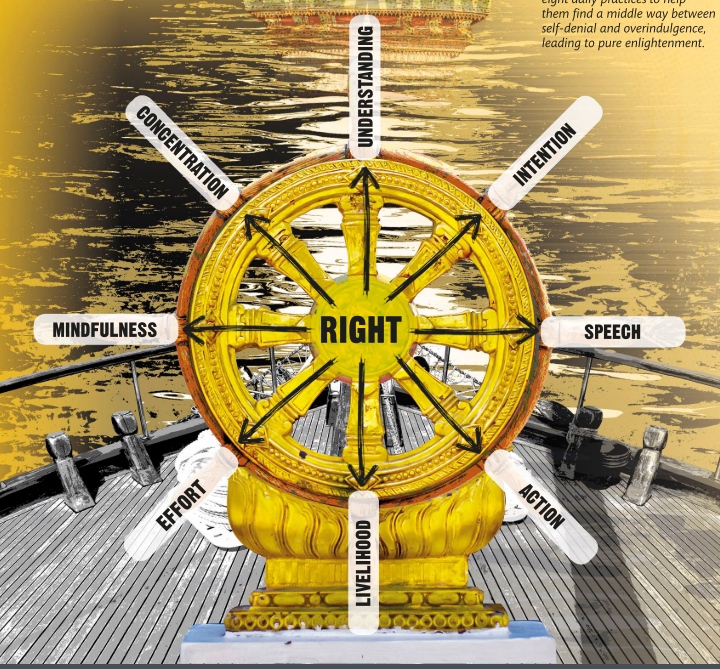
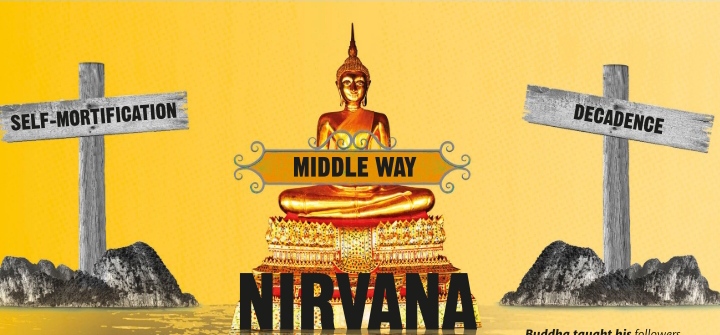
teachings (dharma). He spoke of the Four Noble Truths: dukkha (the truth of suffering); the arising of dukkha (the causes of suffering); the stopping of dukkha (the end of suffering); and the path to the stopping of dukkha (path to freedom from suffering). He also set out the Eightfold Path—eight practices to be integrated into daily life: right understanding, right intention, right speech, right action, right livelihood, right effort, right mindfulness, and right concentration. By embracing these habitual behaviours, the Buddha taught that each person could achieve a balance between self-mortification and decadence known as the Middle Way.
Teachings and legacy
While some of the Buddha’s teachings, such as forbidding the slaughter of living beings, already existed in other schools of thought, his emphasis on equality between human beings and compassion for the poor was a revolutionary concept. The Buddha spent the rest of his life
travelling through India and preaching the dharma. However, he did not claim to be a god or a prophet—only a human being who had reached the highest possible understanding of reality. It is said that when he died he told his disciples not to follow another leader. After the Buddha’s death, his teachings
were passed through eastern Asia orally for 400 years before being written down. He also came to be venerated in other religions, such as the Ahmadiyya sect of Islam, while Hindus see him as one of ten incarnations of the god Vishnu.
DALAI LAMA
Buddhist monk Tenzin Gyatso is the 14th Dalai Lama, and the spiritual leader of Tibet.
The current lineage of Dalai Lamas began in the 14th century, and is believed to be successive incarnations of religious teachers who return to Earth to guide others. Since the 17th century, these spiritual masters have led the government in Tibet, until the 14th Dalai Lama went into exile in 1959 following a failed uprising against Chinese occupation. He has since become a world figure for his campaign for Tibetan autonomy.
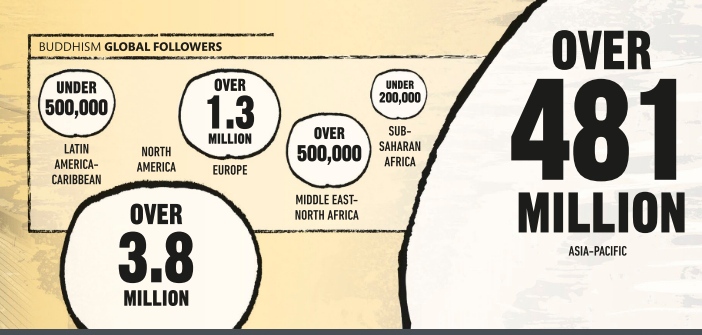
BUDDHISM GLOBAL FOLLOWERS
 Vnoteshistory
Leave a comment